
ARIA
A 42-node autonomous n8n pipeline that aggregates ~1,900 AI/ML articles daily from 14 premium RSS feeds, filters via LLM-based relevance scoring, performs sentiment analysis and keyword tagging, and delivers structured daily briefings and weekly digest reports to Telegram — with stateful cross-run deduplication and dual-AI redundancy at $0/month.
~1,900 from 14 RSS feeds
Articles/Day
$0 /month (dual-AI redundancy)
Operating Cost
42 autonomous nodes
Pipeline Nodes
~1,900 from 14 RSS feeds
Articles/Day
$0 /month (dual-AI redundancy)
Operating Cost
Overview
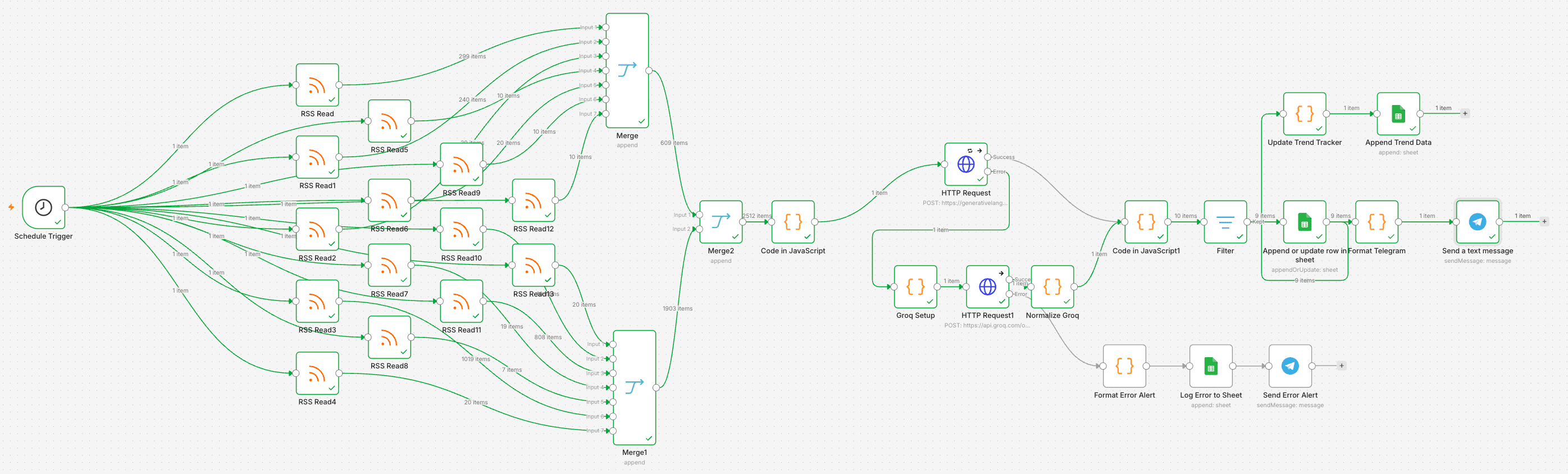
ARIA (Autonomous Research Intelligence Aggregator) is a 42-node autonomous n8n pipeline that monitors 14 premium AI/ML news RSS feeds — including arXiv cs.AI, arXiv cs.LG, KDnuggets, Google AI Blog, OpenAI, DeepMind, Hugging Face, TechCrunch, MIT Technology Review, and others — processing approximately 1,900 articles per day. Each article is filtered for AI relevance, scored 1–10 by Gemini Flash (with Groq LLaMA 3.1 as automatic fallback), saved to a Google Sheet database with sentiment analysis and keyword tagging, and delivered as a daily morning brief to Telegram at 6 AM IST. A weekly digest fires every Sunday at 8 AM. Stateful cross-run deduplication ensures no article appears twice. Operating cost: $0/month.
Technical Architecture
ARIA was the first project in this series — built before VEDA. The key architectural lesson was that pre-building the Gemini request body with JSON.stringify() inside the Code node (rather than using n8n's raw body expression) perfectly handles all edge cases: article titles with quotes, HTML entities in contentSnippet, and newlines in summaries.
Schedule Trigger
Daily 6 AM IST
14 RSS Feed Nodes
arXiv · Google AI · OpenAI · DeepMind · Hugging Face + 9 more
3-Level Merge Chain
Handles n8n's 10-input limit per Merge node
Filter + Dedup + Gemini Body
Keyword filter · staticData dedup · pre-builds JSON body
Gemini AI (Primary)
gemini-flash-latest · relevance score + sentiment + tags
Groq Fallback Chain
llama-3.1-8b-instant · Normalize Groq response format
Quality Gate (≥7/10)
Relevance filter before Sheets save
Google Sheets
12-column database + Trends tab + Error Log tab
Trend Tracker
8-week rolling window · category + tag analytics
Error Alert Chain
Fires when both AIs fail · logs to Sheets + Telegram
Weekly Digest Chain
Every Sunday 8 AM IST · AI-summarized top stories
14-Feed RSS Aggregation
14 RSS Feed Read nodes — arXiv cs.AI, arXiv cs.LG, KDnuggets, Google AI Blog, Simon Willison, Microsoft Research, OpenAI News, Towards Data Science, VentureBeat, TechCrunch, MIT Technology Review, DeepMind Blog, Hugging Face Blog, The Hacker News — are merged via a 3-level Merge hierarchy because n8n's Merge node accepts a maximum of 10 inputs. The final Merge2 output contains ~1,900 articles before keyword filtering.
Dual-AI Analysis Pipeline
The Filter + Dedup Code node pre-builds the Gemini API request body using JSON.stringify() — perfectly escaping all special characters that would otherwise break the HTTP Request node's JSON body. Articles are also stored in $getWorkflowStaticData('global') so the Groq fallback can access them even when Gemini errors out and $input contains the error object.
Stateful Cross-Run Deduplication
$getWorkflowStaticData('global') persists between separate n8n workflow executions. Every saved article link is added to seenLinks on save. On the next run, seenLinks is loaded and any URL already in the set is skipped in the filter stage. The last 500 links are kept (staticData.seenLinks = [...seenLinks].slice(-500)) to prevent unbounded growth.
Trend Tracking & Error Alerting
Trend Tracker runs in parallel after the Google Sheets save — calculates category/tag/score statistics for the current week and maintains an 8-week rolling window. Error Alert Chain fires when both Gemini AND Groq fail (extremely rare) — formats a structured error record with timestamp, node name, and full error details, appends to Error Log tab, and sends a Telegram alert.
Performance Benchmarks
PIPELINE NODES
42
RSS SOURCES
14 premium feeds
ARTICLES / DAY
~1,900 processed
OPERATING COST
$0 / month
Results & Impact
1,900 Articles Processed Daily
14 RSS feeds covering the full AI/ML landscape — research papers, company blogs, industry news, and open-source tools — aggregated, filtered, and scored every morning without human intervention.
Trend Intelligence Over Time
8-week rolling category and tag analytics in the Trends tab — enabling pattern recognition across what topics and entities are dominating AI news week over week.
Dual-AI Redundancy at $0/Month
Gemini Flash (1,500 req/day) + Groq LLaMA 3.1 (14,400 req/day) provide two independent AI providers. Either can fail without missing a single daily brief. Total cost: $0.
“1,900 AI articles filtered to signal. Every morning. Automatically.”
Up next — Customer Orders Analytics ETL Pipeline